-
 info@betataxes.com
-
 Inquire about Tax Services:
+1 437 974 0596
Inquire about Tax Services:
+1 437 974 0596
info@betataxes.com
Inquire about Tax Services:
+1 437 974 0596

 27 March 2026
 8 min read mins read
  1 Comment
 A complete 2026 guide for new immigrants • Beta Taxes CPA
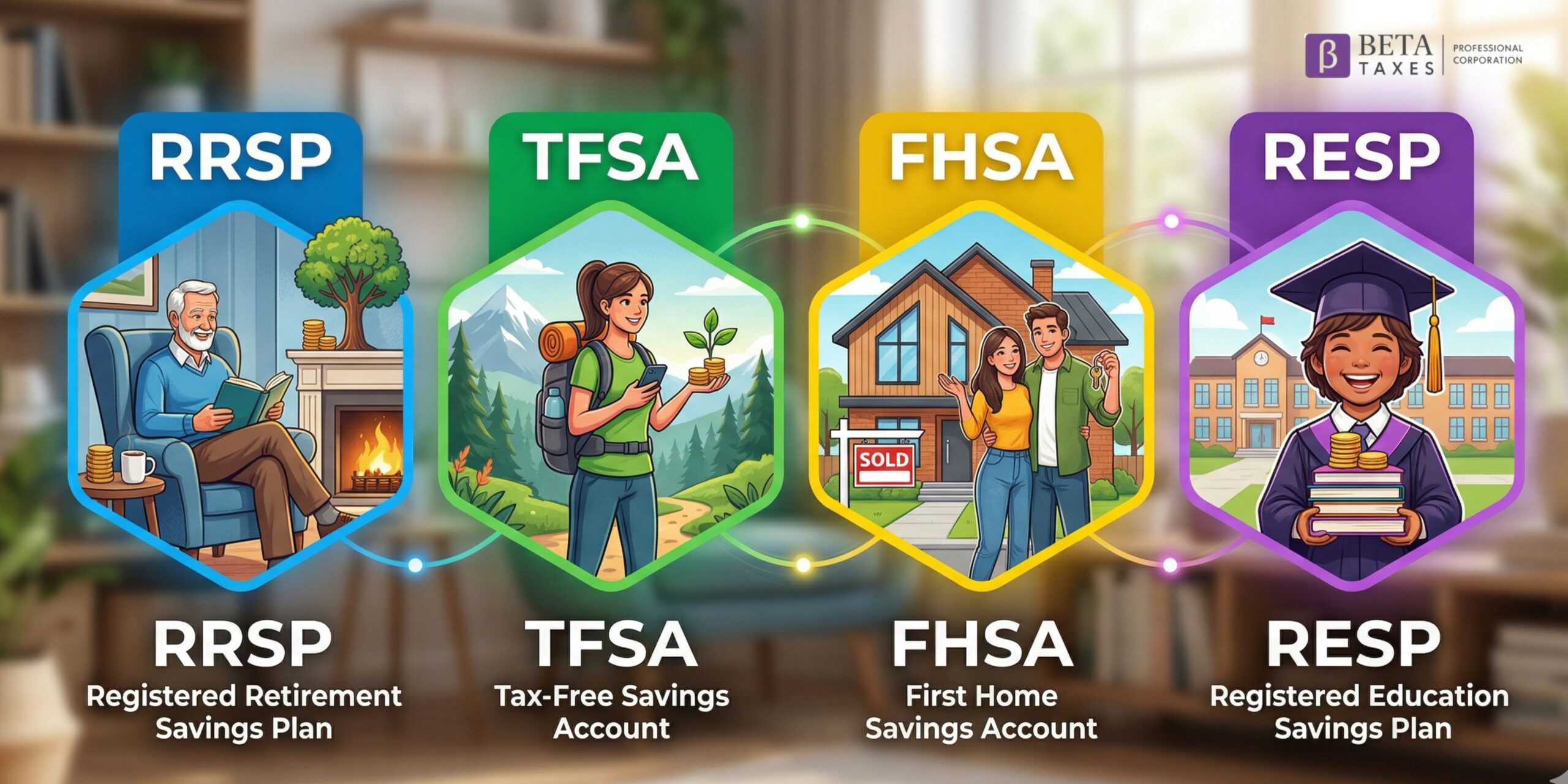
If you’re confused about RRSP vs TFSA Canada, you’re not alone. Understanding RRSP vs TFSA Canada is one of the biggest challenges newcomers face when planning their finances. Many people struggle to choose between RRSP, TFSA, FHSA, and RESP for saving and investing.
With options like RRSP, TFSA, FHSA, and RESP, it’s easy to feel confused because they may sound similar—but each serves a completely different purpose. These are not investments themselves, but tax-advantaged “wrappers” that hold your investments. Choosing the right account at the right time can significantly impact your taxes, savings growth, and long-term financial success in Canada.
| Account | Main purpose | Contribution rule | Tax on contribution | Tax on withdrawal | Best early newcomer use |
| RRSP | Retirement savings | Room generally based on 18% of prior-year earned income | Usually deductible if room exists | Usually taxable | Usually better after CRA room has been created |
| TFSA | Flexible savings and investing | Full annual limit for the year of Canadian residency; not prorated by months | Not deductible | Tax-free | Often the easiest starting point |
| FHSA | Saving for a first home | Room starts when first FHSA is opened; $8,000 first-year room; $40,000 lifetime limit | Generally deductible | Qualifying home withdrawal is tax-free | Very useful if home purchase is a real goal |
| RESP | Saving for a child’s education | No annual limit; however CESG should be considered, $50,000 lifetime limit per beneficiary | Not deductible | Contributions back tax-free; grants/earnings usually taxable to student | Excellent if child can benefit from CESG/CLB |
| Account | Main risk / trap | Special rule people miss | Where it can be opened / what it may hold |
| RRSP | Payroll/group RRSP deductions can create excess contributions | First-year newcomers generally cannot deduct contributions made in that same first filing year, rather a penal interest in charged. | Banks, credit unions, trust companies, insurance companies; may hold cash, GICs, mutual funds, ETFs, stocks, bonds, segregated funds |
| TFSA | People assume they get historical room from before immigrating | A new resident gets the full annual limit for that year, but no room for pre-residency years | Banks, credit unions, trust companies, insurance companies, investment platforms; may hold cash, GICs, mutual funds, ETFs, stocks, bonds, segregated funds |
| FHSA | People open one without checking first-time home buyer rules | Room begins only once the first FHSA is opened | Banks, credit unions, trust companies, insurance companies or other authorized financial institutions; may hold cash, GICs, mutual funds, ETFs, stocks, bonds, segregated funds |
| RESP | Large lump-sum contributions can reduce future grant optimization | Contributing $50,000 on day one does not create CESG on the full amount at once | Banks, credit unions, trust companies, insurance companies or other authorized financial institutions; may hold cash, GICs, mutual funds, ETFs, stocks, bonds, segregated funds |
An RRSP is mainly for retirement savings. Contributions are generally deductible and investment growth is tax-deferred while funds remain inside the plan. The key newcomer issue is that RRSP room usually depends on prior-year earned income. In practice, first-year newcomers generally cannot deduct RRSP contributions made in that same first filing year.
This is why payroll RRSP deductions through an employer can create a problem. The payroll system may keep contributing even though actual deduction room does not exist yet. If contributions exceed the limit by more than the $2,000 cushion, CRA may assess a 1% monthly excess-contribution tax.
Regular RRSP withdrawals are usually taxable. Two major exceptions are the Home Buyers’ Plan and the Lifelong Learning Plan. Under the Home Buyers’ Plan, eligible taxpayers can currently withdraw up to $60,000 from RRSPs to buy or build a qualifying home, and the amount is generally not taxed immediately if the program rules are followed and the amount is repaid over time. Under the Lifelong Learning Plan, eligible taxpayers can withdraw up to $10,000 in a calendar year and up to $20,000 in a participation period for eligible education or training for themselves or their spouse or common-law partner.
Many taxpayers confuse T1-OVP and T3012A, but they serve very different purposes. T1-OVP is the CRA return used to calculate and report the tax on excess RRSP contributions, including the 1% monthly tax that may apply when contributions exceed the allowable limit. T3012A, on the other hand, is not a penalty form. It is the CRA process used when certain unused RRSP contributions are being withdrawn without withholding tax, subject to CRA approval. Put simply, T1-OVP is about calculating the excess contribution tax, while T3012A is about requesting a tax-efficient withdrawal of eligible unused contributions.
A TFSA is one of the most flexible registered accounts in Canada. Contributions are not deductible, but investment growth and withdrawals are generally tax-free.
The newcomer rule that people miss is this: if you become a resident of Canada at any time during the year, and you are otherwise eligible, you generally receive the full annual TFSA dollar limit for that year. It is not prorated by the number of months you lived in Canada. For 2026, that annual limit is $7,000.
However, newcomers do not get TFSA room for the years before they became Canadian residents. Room starts from the year of Canadian residency only. Withdrawals are generally tax-free, but over-contributions can still trigger a 1% monthly tax.
The FHSA combines two attractive tax features: contributions are generally deductible, and qualifying withdrawals to buy or build a first home are generally tax-free.
To open an FHSA, a person generally must be a resident of Canada, old enough to enter into the contract in their province, a qualifying first-time home buyer, and 71 or younger by December 31 of the year the account is opened.
Unlike TFSA, FHSA room does not start automatically just because you became a resident. FHSA participation room starts only when you open your first FHSA. The first-year participation room is $8,000 and the lifetime FHSA limit is $40,000
An RESP is designed for post-secondary education savings. Any adult can open one for an eligible beneficiary. There is no annual RESP contribution limit, but there is a $50,000 lifetime contribution limit per beneficiary across all RESPs.
RESP is especially valuable because of federal incentives. The basic Canada Education Savings Grant (CESG) is 20% of eligible annual contributions, up to $500 per year. If there is unused grant room from prior years, the plan may receive up to $1,000 of basic CESG in one year. The lifetime CESG maximum is $7,200 per child.
For eligible lower-income children, the Canada Learning Bond (CLB) may provide an initial $500 and then $100 for each additional year of eligibility, up to a $2,000 lifetime maximum. No personal contribution is required to receive the CLB.
A very common planning question is whether contributing $50,000 on day one is a good idea. It is legal from a contribution-limit perspective, but CESG will not be paid on the full $50,000 at once. Because CESG is tied to annual grant rules, a large lump-sum contribution can reduce the ability to optimize future annual grant room.
RESP withdrawals are also different from RRSP withdrawals. Refunds of contributions can generally come back tax-free. Educational Assistance Payments (EAPs), which include government grants and investment earnings, are generally taxable to the student beneficiary.
Can I open these accounts with an insurance company?
Yes. RRSPs and FHSAs can be opened through issuers such as banks, credit unions, trust companies, and insurance companies & other authorized financial institutions. If the product is opened through an insurance company, the money may sometimes be invested in segregated funds rather than ordinary mutual funds.
If I become a Canadian resident late in the year, is my TFSA limit reduced?
No. TFSA room is not prorated by months. If you become a resident at any time during the year and are otherwise eligible, you generally receive the full annual TFSA dollar limit for that year.
Can I deduct RRSP contributions in my first year in Canada?
Generally, no. First-year newcomers generally cannot deduct RRSP contributions made in that same first filing year because the room usually depends on prior-year Canadian earned income.
Are RRSP withdrawals always taxable?
Regular RRSP withdrawals are usually taxable. HBP and LLP withdrawals can avoid immediate tax if CRA’s program rules are followed.
Can I contribute $50,000 to an RESP on day one?
Yes, that is within the lifetime contribution limit. But CESG will not be paid on the full $50,000 at once, so a large lump-sum contribution can reduce future annual grant optimization.
Beta Taxes helps newcomers review not just the account names, but the real planning questions: whether contribution room exists, whether the money is deductible, whether a withdrawal should be regular or under special program rules, whether FHSA eligibility is met, and whether RESP grants or bonds are being maximized properly.
Source note: Content fact-checked against current CRA and Government of Canada guidance available in March 2026.
Comments are closed.






Excellent blog post. Clean and simple. We need more of this.